HERE AS ME JOURNAL / FIND YOUR FIT
A practical guide to choosing a chest binder size, reading brand-specific charts and asking useful questions when you fall between sizes.
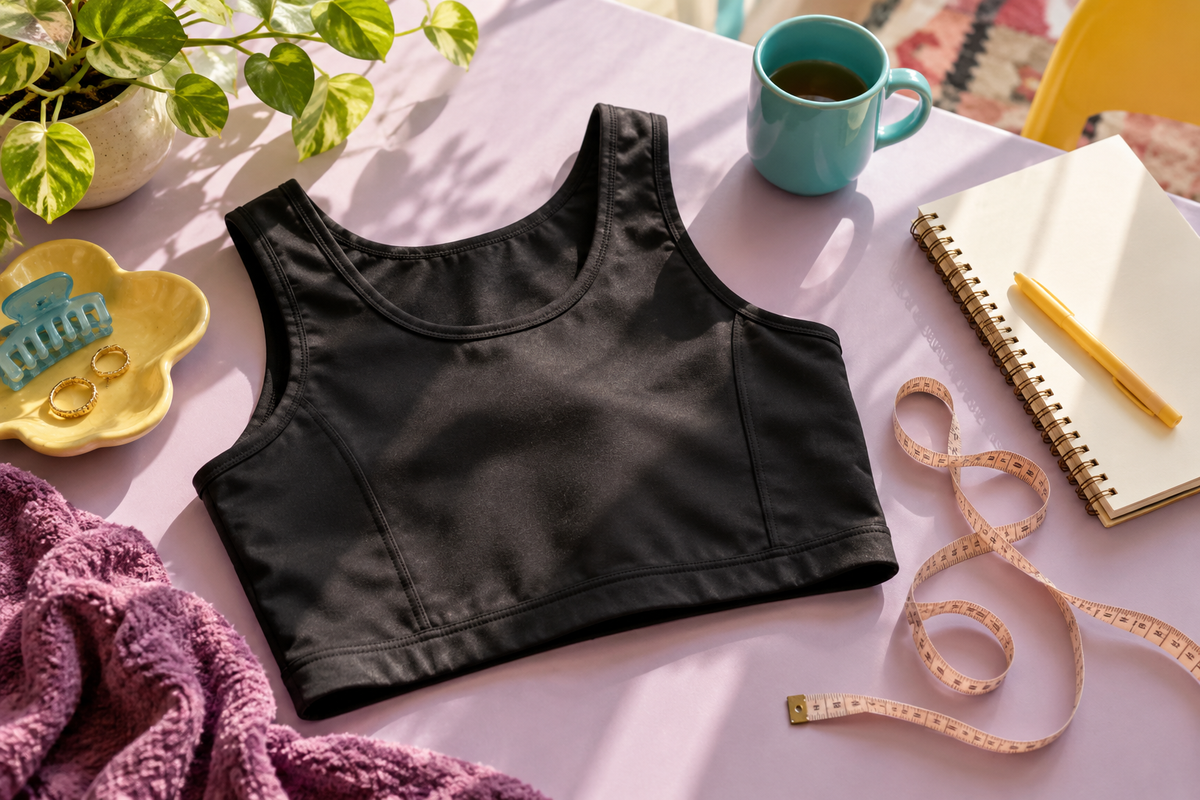
Image: original AI-generated editorial illustration. Garments and people shown are illustrative, not photographs of finished HERE AS ME products.
01 /
A size label is only the beginning
If you have searched “how to choose a chest binder size,” you have probably seen several different charts. Resist the urge to combine them into one universal rule. A medium from one maker is not automatically equivalent to a medium from another, and different styles within a brand may have separate instructions.
The useful starting point is the current chart attached to the exact garment you are considering. Save the product name and a link to that chart together. This is especially helpful when several browser tabs, colour options or second-hand listings start to blur together.
02 /
Build a simple measuring setup
Have a flexible measuring tape, a mirror if useful, and somewhere to record the results. Read the maker's instructions before beginning so you know which measurements it asks for and how each is defined. If someone helps, share the instructions with them first and agree on what assistance you are comfortable with.
Record the unit beside every number. Centimetres and inches are easy to confuse when copying notes between a phone and a product page. Include the date, since a saved measurement from an earlier purchase may no longer describe your current body.
Do not treat the illustrative tape in our image as a placement guide. Follow the diagrams or instructions supplied for the product itself.
03 /
Follow the chart’s own method
Some makers ask for more than one chest measurement or include shoulder measurements. For example, gc2b publishes its own measuring method and offers help interpreting measurements. That method belongs to its products; it is not a HERE AS ME size chart.
Measure without trying to create the result you want the garment to produce. Follow the specified posture and tape placement, and repeat a measurement if you are uncertain. If your readings vary, pause and ask the brand how it wants you to measure rather than selecting whichever number lands in your preferred size.
04 /
Between sizes? Ask a better question
Being between chart ranges is a reason to contact the maker. Do not automatically round down. Canada's Department of National Defence binding guidance warns against choosing an undersized binder and advises using manufacturer sizing instructions.
Send the exact style name, the measurements the chart requests, their units and the part of the chart that is unclear. You do not have to send photos of your body to ask a sizing question. Start with written measurements and ask what information is actually necessary.
Try this message: “I am considering [style]. My measurements are [numbers and units], taken using your guide. They fall across [sizes]. Which size do you recommend, and what is the exchange process if the fit is unsuitable?”
05 /
A chart recommendation still needs a fit check
Once the garment arrives, read the return conditions before a try-on. Keep the packaging and tags while you check the fit. Follow the maker's dressing instructions and make sure you can remove it without forcing it.
The Canadian guidance describes being able to breathe comfortably and move your shoulders. Pain, breathing difficulty or numbness are reasons to remove the garment; persistent or severe symptoms need medical attention. A size chart cannot assess an individual's health or guarantee a symptom-free experience.
If the fit is wrong, describe the problem specifically when asking for help: where the garment catches, which edge digs in or whether removal is difficult. A concrete description is more useful than simply saying “it feels weird.”
06 /
Keep a private fit note
A short record can save time on your next purchase: brand, style, size, date, measurements and the outcome of your try-on. Add practical observations about the neckline and hem with your own clothing. Keep these notes somewhere you control; there is no need to publish personal measurements in a public review.
Recheck the current chart before reordering. Product patterns and your measurements can change. At HERE AS ME, use the final size guide for the finished product when it becomes available; the garment concepts shown in this Journal are not a sizing reference.
A few things you might be wondering
Can I use my bra size to choose a binder?
Use the exact measurements requested by the binder maker. A familiar underwear size is not a substitute for the product’s chart.
What if the chart and my usual clothing size disagree?
Ask the manufacturer to interpret the chart with your measurements. The letter on your T-shirt is not the deciding evidence.